The published English section is comprehension, and there is no writing task. Below is an original passage with ten worked questions in the five-option format our papers use, the four question families they belong to, and an honest account of where spelling and grammar sit.
What is in the English part of an 11 plus paper?
One named area, and it is comprehension. The West Midlands Grammar Schools consortium publishes that each paper is “divided into smaller individually timed sections that test: English Comprehension, Verbal Reasoning, Mathematics, Non-Verbal/Spatial Reasoning”. Source: West Midlands Grammar Schools, the entrance test, checked 6 September 2026.
There is no writing task. The King Edward VI Foundation states plainly that “there are no sections of writing within the test”, and that “all questions are multiple choice and children record their answers on a separate answer sheet”. Source: King Edward VI Foundation, entrance test information, checked 6 September 2026. In our own experience families arriving from other parts of the country often prepare for a story or an essay that this arrangement does not ask for.
English matters more than its own section suggests, because of how the result is weighted. The consortium publishes “50% for English/verbal reasoning, 25% for non-verbal reasoning and 25% for mathematics”. English and verbal reasoning together are half the marks, and both run on the same underlying thing: a large, secure vocabulary and the habit of reading closely.
A passage, and ten questions on it
Below is a short passage written for this page, followed by ten questions in the five-option format our own papers use. No admissions authority publishes how many options its questions carry, so read the shape as ours rather than as a claim about the live paper.
Give your child a stretch of uninterrupted time and let the clock run, reading included, so pace is part of what you see. Let them go back to the passage as often as they like. Going back is the skill.
The lamp had gone out twice already that night, and Nell had stopped pretending she was not frightened.
Her father had rowed to the mainland at noon for oil and flour, promising to be back before the tide turned. The tide had turned. It had turned again. Now the wind came at the tower in long shoves, as though something outside were leaning on it to see whether it would give.
She climbed the ninety-two steps with the spare wick in her apron pocket and her candle guttering at every landing. At the top, the glass room was cold as a church. Nell knelt, trimmed the wick with numb fingers, and struck the match on the third attempt.
The flame took. The great lens caught it, multiplied it, and flung a long white arm out across the water, and Nell watched it sweep the dark until it found the ragged shape of a fishing boat, close in, far too close, its sail down and its crew waving both arms above their heads.
She did not remember deciding to run.
Written for this page by Pathway Eleven. It is not from any past paper.
-
Question 1 · Retrieval, why her father left
Why had Nell's father gone to the mainland?
Answer: D. Straight retrieval, and the sentence says so. Questions like this are free marks, and they are lost only by children who answer from memory instead of going back to the line.
-
Question 2 · Retrieval, a number written in words
How many steps did Nell climb?
Answer: C. The number is written in words in the passage, which is exactly why it slips past a fast reader looking for digits.
-
Question 3 · Inference, what two short sentences tell us
“The tide had turned. It had turned again.” What do these two short sentences tell us?
Answer: A. Inference from a promise made earlier in the passage. He said he would be back before the tide turned; it has now turned twice. The short sentences also slow the reader down, which is the effect the writer wanted.
-
Question 4 · Vocabulary, guttering
In “her candle guttering at every landing”, what does guttering mean?
Answer: B. Vocabulary in context. Nothing in the sentence defines the word, so a child has to use the cold, the wind and the stairwell around it. This is the question type that most rewards wide reading and least rewards word lists.
-
Question 5 · Craft, the wind in long shoves
Why does the writer say the wind came “in long shoves, as though something outside were leaning on it”?
Answer: E. A question about the writer's craft. The test is not whether a child knows the word for the device, but whether they can say what it does to the reader.
-
Question 6 · Vocabulary, cold as a church
“The glass room was cold as a church.” This suggests the room was
Answer: C. The comparison is doing the work, and the passage backs it: a room made of glass at the top of a tower, reached by ninety-two steps, with nobody in it. Cold is stated and bareness follows from what is described. Option A is the trap for a child who takes the comparison literally and reads a church as holy rather than as cold and empty.
-
Question 7 · Inference, why the crew were waving
Why were the crew of the fishing boat waving both arms above their heads?
Answer: C. Inference assembled from three details: the sail is down, the boat is far too close in, and the arms are above the head. No single line says it.
-
Question 8 · Vocabulary, ragged
The boat's shape is described as ragged. Here the word means
Answer: B. The everyday meaning is about cloth, and the passage is using the extended one. Words with a common meaning and a stretched one are a favourite of this section.
-
Question 9 · Grammar, its without an apostrophe
In “its sail down and its crew waving”, why is its written without an apostrophe?
Answer: D. Grammar, asked inside the passage rather than as a rule. This is how grammatical accuracy tends to surface in a comprehension section.
-
Question 10 · Craft, the last sentence
What does the last sentence, “She did not remember deciding to run”, mainly show?
Answer: A. Structure and effect. The writer ends on the moment of action rather than the action itself, and the point is the speed of the decision. Option C is chosen by children who read did not remember as did not.
The four things a comprehension section is really asking
Every question above belongs to one of four families, and a child who can name the family they are in answers faster, because each family has its own first move.
| Family | What it asks | First move |
|---|---|---|
| Retrieval | Something the passage states outright. | Find the line. Do not answer from memory, ever. |
| Inference | Something the passage implies across two or three details. | Collect the details first, then choose. The answer is never in one place. |
| Vocabulary in context | What a word means here, which may not be what it usually means. | Cover the word, read the sentence, and decide what would fit the gap. |
| Craft and effect | Why the writer did something: a comparison, a short sentence, an ending. | Ask what changes for the reader if it were written plainly instead. |
Want this practised properly rather than once? Create a free account: the Starting Assessment covers comprehension among the four areas, and the daily plan works whichever family your child is weakest on.
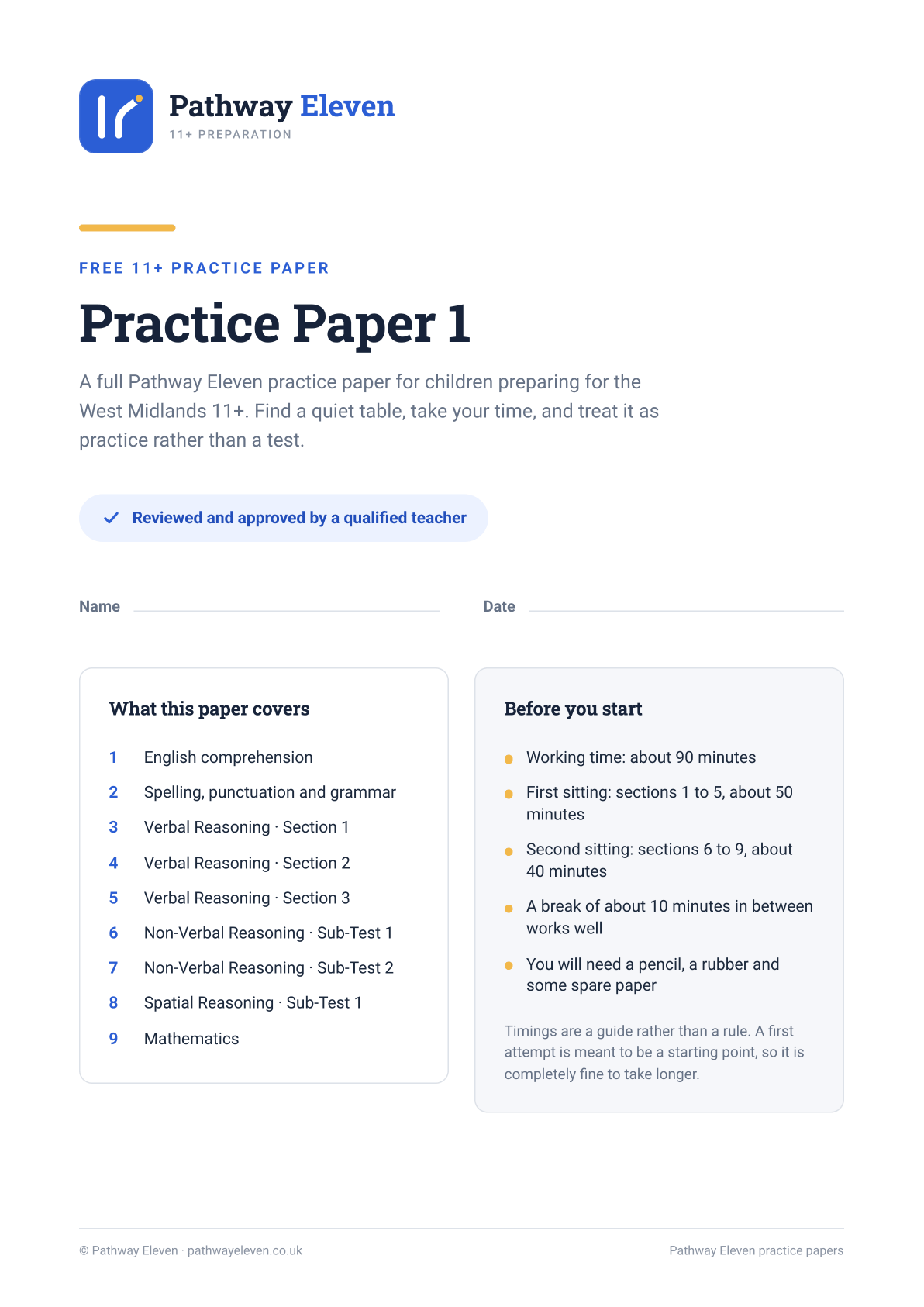
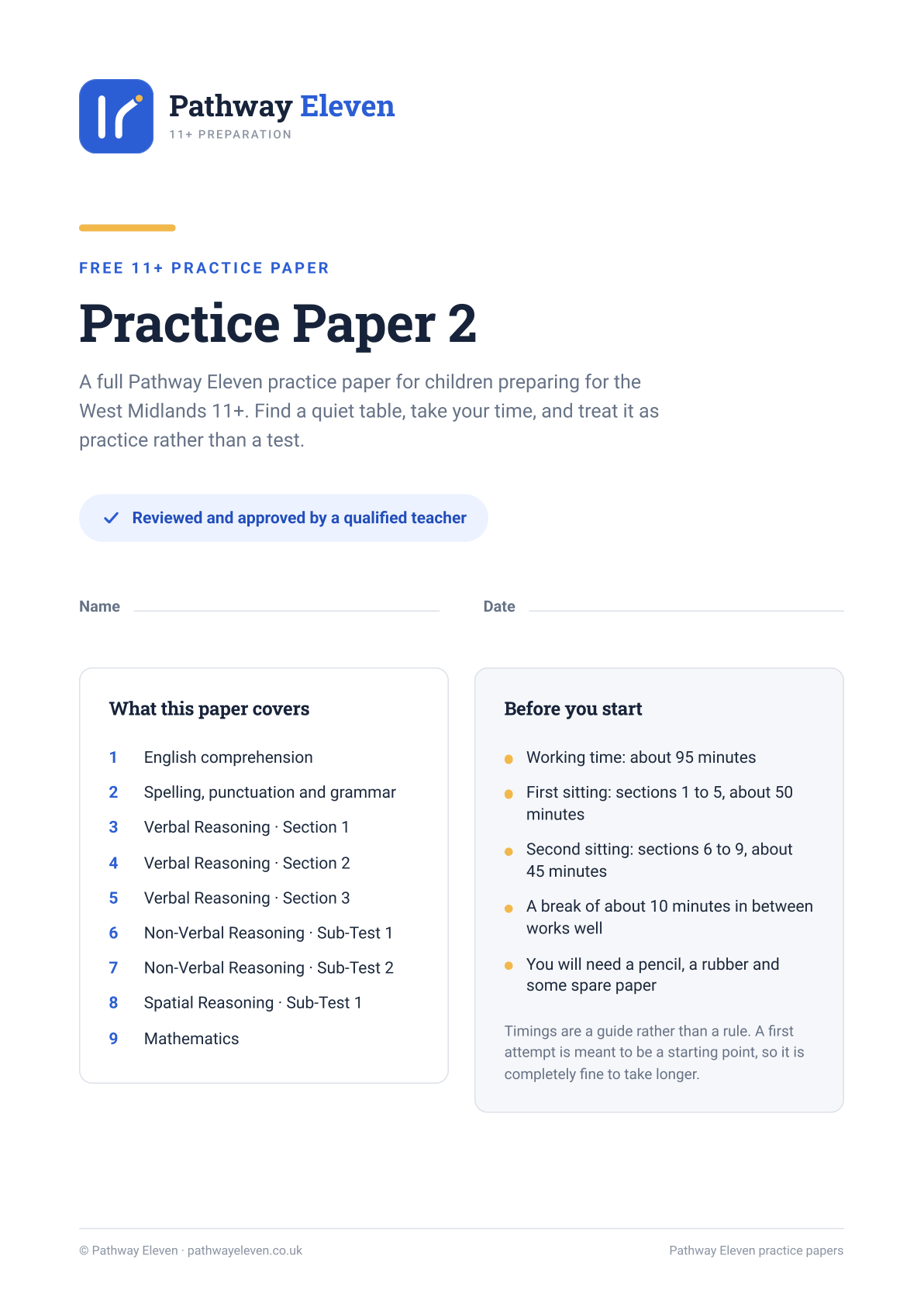
- Two complete papers in the published format
- Answer sheets and worked answers
- Sent to your inbox in a minute
Each paper opens with a complete comprehension passage and its questions.
Check your inbox
We have sent a confirmation link to the address you gave. Your practice paper pack arrives as soon as you confirm.
Not there in a minute? Check spam/promotions. If it still has not arrived, email info@pathwayeleven.co.uk and we will send it again.
Check your inbox
Your practice paper pack is on its way to the address you gave. It arrives as a link, so you can open it on whichever device you would rather print from.
Not there in a minute? Check spam/promotions. If it still has not arrived, email info@pathwayeleven.co.uk and we will send it again.
Written and reviewed by a qualified teacher, for the West Midlands exam.
Your first name and address are used only for these emails. Privacy Notice.
Where do spelling, grammar and writing sit?
Writing does not sit anywhere: the King Edward VI Foundation publishes that “there are no sections of writing within the test”, so there is no story, no essay and no extended answer to prepare. Whether the 11 plus includes creative writing covers the areas that do set one and what changes if you are applying outside the shared test.
Spelling, punctuation and grammar are not in a section of their own either, on the published evidence. The four areas the consortium names are English comprehension, verbal reasoning, mathematics and non-verbal or spatial reasoning, and none of the sources we read publishes a separate spelling or grammar section.
That is not a reason to skip them. Grammatical precision surfaces inside comprehension, as question nine above shows, and vocabulary and word building run right through verbal reasoning, which shares the fifty per cent. The rules are also finite, which makes them cheap ground to make secure. What we would not do is let that ground crowd out reading, because reading is the part that takes years.
Our own practice papers do carry a short spelling, punctuation and grammar section, because a printable paper is also a diagnostic and it is useful to see those errors isolated. That is a choice we made about our papers, not a description of anybody else's.
What kind of reading actually builds this?
Longer than a school reading book, and older than a child would choose alone. Passages set at this level tend to be literary fiction or narrative non-fiction, frequently written some decades ago, with sentence shapes and vocabulary a modern children's novel has smoothed away. That is our own observation from the papers we write and mark, rather than a published fact, and we would rather say so.
What follows from it is practical. A child who reads only contemporary fiction meets almost none of the sentence patterns that make a comprehension passage feel hard, so the difficulty on the day is unfamiliarity rather than ability. Mixing in something older, read together and out loud if that is what it takes, does more for this section than a workbook will.
Two habits are worth more than any amount of practice paper. Ask what a word means when it comes up, rather than saving it for a list. And ask, once a chapter, why the writer chose to do something a particular way, which is the craft-and-effect family met in its natural home.
Our comprehension guide takes the technique further, and the vocabulary page covers how a word store is built without lists.
A note on marking these
Mark them with your child rather than for them, and go in the order of the four families rather than question by question. If the retrieval questions were wrong, the problem is going back to the text and it is fixed this week. If the inference questions were wrong, the problem is patience, and it takes a term. If vocabulary was wrong, the answer is books rather than exercises.
Resist a total out of ten. Ten questions on one passage measures one passage. What you are looking for is a family, and a family is a plan.
Questions parents ask about 11 plus English papers
Is there a writing task in the 11 plus English paper?+
Not in the shared West Midlands test. The King Edward VI Foundation states that there are no sections of writing within the test and that all questions are multiple choice. Some independent schools do set a written paper, so check the arrangements for the schools you are applying to.
How long is the English section?+
No body we read publishes a length for the English section on its own. What is published is the paper: the consortium says two papers of approximately 50 to 60 minutes each, divided into smaller individually timed sections, and the King Edward VI Foundation says approximately 60 minutes. We have left those figures as each body published them, because averaging two official numbers would produce a third that nobody publishes.
Should we practise spelling and grammar separately?+
A little, and not at the cost of reading. No source we read publishes a separate spelling or grammar section, but grammatical precision surfaces inside comprehension and vocabulary runs through verbal reasoning, which shares the fifty per cent weighting. The rules are finite, so they are cheap ground to secure.
What sort of books should my child be reading?+
Longer than a school reading book and older than they would choose alone. Passages at this level tend to be literary fiction or narrative non-fiction written some decades ago, which is our own observation from the papers we write rather than a published fact. Reading something older aloud together counts.
Where did this passage come from?+
We wrote it for this page. No past paper for this test is published by anybody, so nothing on this site is drawn from one, and any site offering a past paper for the West Midlands test is offering a reconstruction.
How many questions should a child get right?+
It is the wrong measure on ten questions from one passage. What is worth reading is the pattern: whether the wrong answers cluster in retrieval, inference, vocabulary or craft, because each of those four needs a different response from you.
Where to go next
- 11 plus past papers, what exists for this test and what to use instead.
- 11 plus English explained, the subject across Year 3 to Year 5.
- 11 plus English comprehension, the technique, question by question.
- 11 plus vocabulary, building a word store without lists.
- 11 plus verbal reasoning papers, the other half of the fifty per cent.
- Does the 11 plus include creative writing?, the published answer for this test.
- Two full papers with their mark schemes, sent to your inbox.
- What Pathway Eleven costs, one plan, every subject.
Comprehension is one of the four areas the Starting Assessment covers, and the plan weights itself towards the weakest.
What we read about the English paper, and when
The passage and the ten questions above are Pathway Eleven's own. Every statement about the test itself was read at its published address on 6 September 2026. Pathway Eleven is an independent service and is not affiliated with or endorsed by GL Assessment.
- West Midlands Grammar Schools, the entrance test, the four section areas, the multiple-choice answer sheet and the weighting. Checked 6 September 2026.
- King Edward VI Foundation, entrance test information, that there are no sections of writing within the test. Checked 6 September 2026.
- Warwickshire County Council, the 11 plus test, the four sections named as English, verbal reasoning, non-verbal reasoning and mathematics. Checked 6 September 2026.
- GL Assessment, free 11 plus materials, the free English familiarisation papers and the printed practice booklets. Checked 6 September 2026.