A verbal reasoning test asks a child to work out words, codes and letter patterns under time pressure. A mock test is the same thing sat as one full timed section rather than as loose practice. Ten original questions are worked through below, with the alphabet habit that unlocks half of them.
Why does verbal reasoning carry so much of the paper?
Because it is bundled with English in the published weighting. The West Midlands Grammar Schools consortium states that “the weightings for the test results are 50% for English/verbal reasoning, 25% for non-verbal reasoning and 25% for mathematics”, and lists verbal reasoning as one of the areas each paper's individually timed sections test. Source: West Midlands Grammar Schools, the entrance test, checked 6 September 2026. Warwickshire County Council names the same four sections for the same test. Source: Warwickshire County Council, the 11 plus test, checked 6 September 2026.
Half the marks, then, sit with words. And verbal reasoning is the one area school does not normally teach, which produces the familiar situation of a strong reader meeting a letter-code question for the first time and concluding they are bad at it. They are not. They have never seen one.
One caveat for anyone reading from outside the region. The shared West Midlands test names verbal reasoning as an area of its own, and the worked set below is written for that shape. Other arrangements do not all separate it: the assessment now published at the cem.org address groups verbal ability with numerical and non-verbal ability instead. GL Assessment or CEM, which test does my child sit sets out what each body publishes.
That is the good news about this section. A large part of it is format rather than ability, and format is learnable in a way that reading stamina is not.
The one thing to know before any of it
Half the question types on a verbal reasoning paper run on the alphabet as a number line, so a child who counts from A every time runs out of clock long before they run out of ability. Our verbal reasoning question-types page teaches the alphabet strip habit in full, with the reversed and halfway cases worked through.
Everything below assumes that much. If it is not automatic yet, make it automatic first: it is days of work, and it is the cheapest set of marks on this paper.
Ten worked questions across the common types
These are ours, written for this page in the five-option format our own papers use. No admissions authority publishes how many options a question carries, so treat the shape as a description of our material rather than of anybody else's. Work through them with your child and read the reasoning aloud: the reasoning is the teachable part.
-
Question 1 · Synonyms, closest in meaning
Which word is closest in meaning to OBSTINATE?
Answer: B. A pure vocabulary question wearing a reasoning hat. Nothing can be worked out here: either the word is known or it is guessed, which is why reading does more for verbal reasoning than puzzle practice does.
-
Question 2 · Antonyms, most opposite in meaning
Which word is most opposite in meaning to SCARCE?
Answer: E. Opposites are harder than synonyms because the wrong options are chosen to be loosely related. Hidden tempts a child who half-knows scarce as hard to find.
-
Question 3 · Odd one out
Which is the odd one out?
Answer: D. Four trees and a thistle. The move to teach is to say the category out loud before looking at the options, because the options are written to suggest a second, wrong category.
-
Question 4 · Letter series
What comes next in this series? CE, GI, KM, OQ, ?
Answer: C. Track the letters separately. The first letters go C, G, K, O, each four on, so the next is S. The second letters go E, I, M, Q, also four on, so the next is U. Splitting the pair into two series is the whole technique.
-
Question 5 · Letter codes
If GARDEN is written in code as HBSEFO, how is SHED written?
Answer: A. Every letter has moved one place forward in the alphabet. Apply the same shift: S becomes T, H becomes I, E becomes F, D becomes E. Option B applies the shift backwards, which is an easy slip to make under time.
-
Question 6 · Hidden words
A four-letter word is hidden across the end of one word and the start of the next. Find it: I do not like this ingredient at all.
Answer: B. The word runs from the end of this into the start of ingredient: s, i, n, g. REDI and IENT sit inside a single word, THIN appears nowhere in the sentence, and HISI does cross the join but is not a word. The test is both things at once: it must cross a join, and it must be a word.
-
Question 7 · Compound words
Take one word from each group to make a new word. First group: car, tea, sun. Second group: pot, nut, den.
Answer: D. Teapot. Work along the first group rather than the second: three first words against three second words is nine combinations, and saying them aloud in order finds the real one faster than staring.
-
Question 8 · Number series
What is the next number in this series? 3, 7, 15, 31, ?
Answer: D. Each number is double the one before plus one: 3 to 7, 7 to 15, 15 to 31, so 31 doubled is 62 and one more is 63. Children who test only the differences find 4, 8, 16 and often stop before noticing the rule underneath.
-
Question 9 · Analogies
Chapter is to book as scene is to
Answer: A. The relationship is part to whole. Naming the relationship in words before reading the options is the move: everything on this list is connected to a scene, and only one is connected in the same way.
-
Question 10 · Missing letters
The same letter ends the first word and begins the second. What is it? PLAN (?) (?) OAST
Answer: E. T gives PLANT and TOAST. Test each letter against both fragments, never one: E, K and S all finish PLAN but none of them starts a word ending OAST, and R starts ROAST but leaves PLANR. Only T satisfies both ends at once.
Which verbal reasoning types improve in a week, and which take a term?
Not all of it moves at the same speed, and knowing which is which stops a family spending October on the part that was going to be free anyway.
| Family | Examples above | How fast it moves |
|---|---|---|
| Alphabet and code work | Letter series, coded words, missing letters | Fast. A rule, a worked example and some repetition. Days rather than terms. |
| Pattern spotting | Number series, letter connections | Fast once the child knows to test doubling and adding, not only differences. |
| Word building | Compound words, hidden words | Medium. It is a searching method, and methods need repetition to become quick. |
| Vocabulary | Closest meaning, opposites, odd one out | Slow, and the largest share. Built by reading over years, not by lists in the spring. |
The uncomfortable implication is that the fastest-moving families are also the smallest. Vocabulary is where most verbal reasoning marks live, and vocabulary is the one thing that cannot be bought in the final term. That is the strongest argument we know for starting in Year 3 with books rather than in Year 5 with workbooks.
Want the fast families taught and the slow one worked daily? Create a free account: guided teaching handles the types your child has not met, and the daily plan keeps returning to the ones that need time.
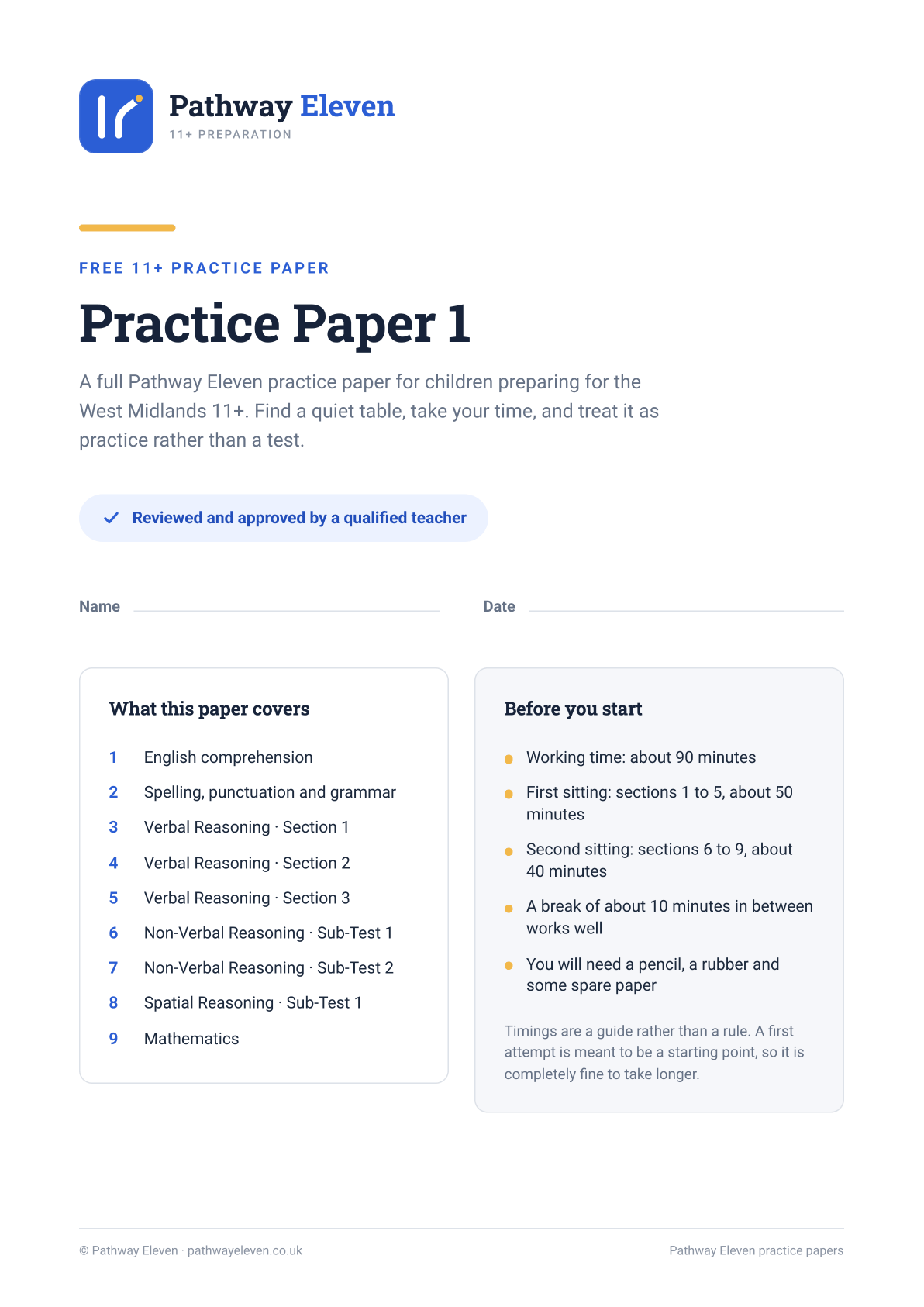
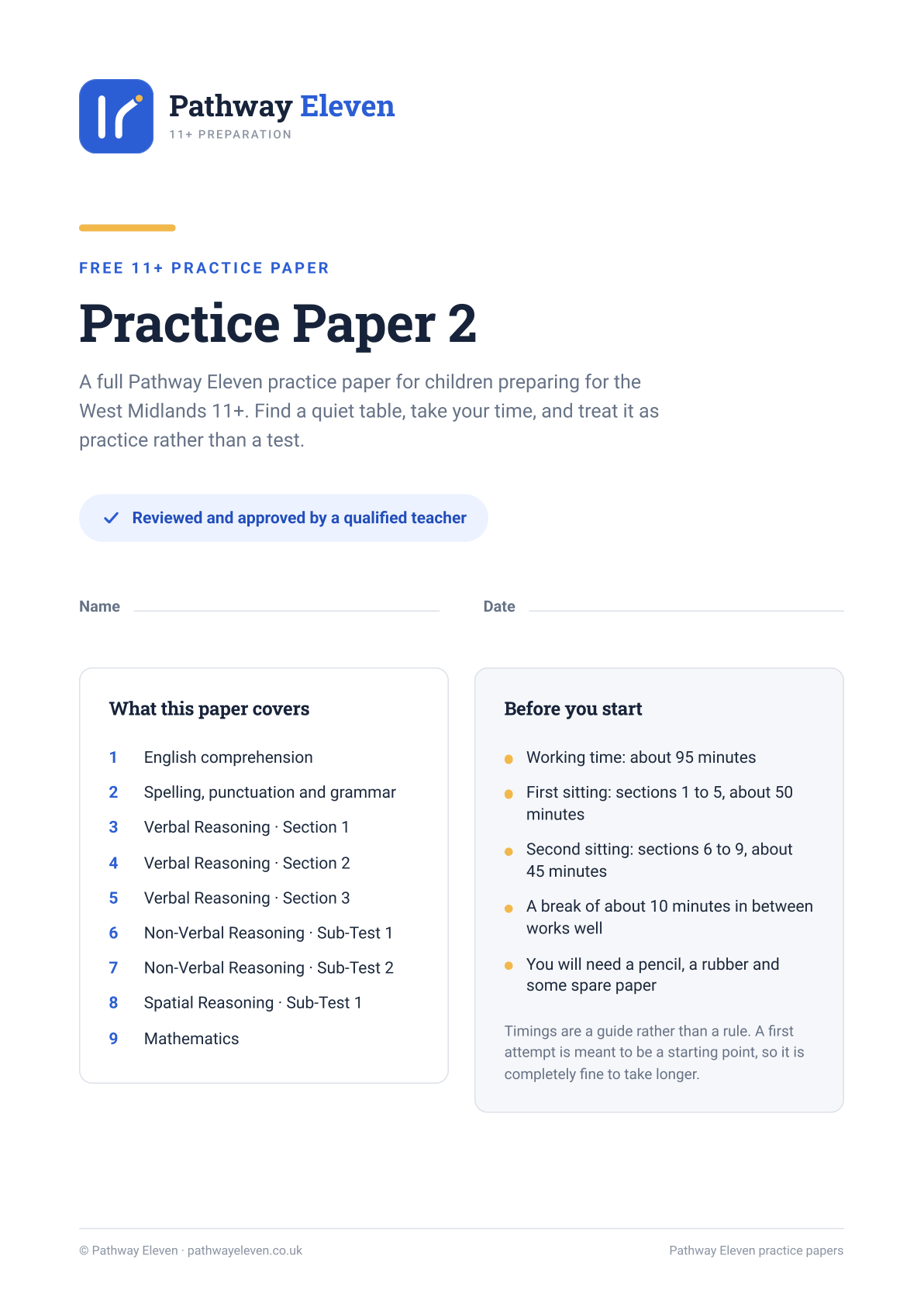
- Two complete papers in the published format
- Answer sheets and worked answers
- Sent to your inbox in a minute
Three verbal reasoning sections in each paper, each timed on its own.
Check your inbox
We have sent a confirmation link to the address you gave. Your practice paper pack arrives as soon as you confirm.
Not there in a minute? Check spam/promotions. If it still has not arrived, email info@pathwayeleven.co.uk and we will send it again.
Check your inbox
Your practice paper pack is on its way to the address you gave. It arrives as a link, so you can open it on whichever device you would rather print from.
Not there in a minute? Check spam/promotions. If it still has not arrived, email info@pathwayeleven.co.uk and we will send it again.
Written and reviewed by a qualified teacher, for the West Midlands exam.
Your first name and address are used only for these emails. Privacy Notice.
How do you practise verbal reasoning at home?
In small pieces, and by type rather than by paper. A mixed section is the right thing to sit occasionally and the wrong thing to learn from, because a child who meets one code question a fortnight never gets fast at code questions.
The sequence we would use: meet one type properly with a worked example, do a handful untimed until the method is automatic, then meet it inside a mixed timed section a week later. That last step is the one families skip, and it is where the skill actually becomes usable, because the real difficulty in a section is recognising which type you are looking at.
Two things to avoid. Do not let your child guess and move on without naming what the question wanted, because an unnamed question type is one they will not recognise next time. And do not turn vocabulary into a list. A word met in a story has a context attached and a word met on a list does not, which is why the list is forgotten by the spring.
Our verbal reasoning question-types page walks the full set, and the vocabulary guide covers the slow half properly.
Reading the result, type by type
Mark by type, not by total. Write the ten question types down the side of a page and tick them, and the shape of the problem appears immediately: a child who lost three marks across three unrelated types has a pace problem, and a child who lost three on codes has a single teaching problem to fix.
One more thing worth watching. Our own papers carry no penalty for a wrong answer, so on our papers a blank scores the same as a wrong one and forfeits the chance of a right one. No body publishes the marking scheme for the live test, so read the instructions your allocated centre issues rather than assuming. If your child left items empty, that is a strategy conversation rather than a subject one.
Questions parents ask about verbal reasoning papers
How many verbal reasoning sections are on the paper?+
No body publishes a count. What the consortium publishes is that each of the two papers is divided into smaller individually timed sections, and that verbal reasoning is one of the four areas those sections test. Our own practice papers carry three verbal reasoning sections in each paper, which is a description of our material rather than of the live test.
Why does my child find it hard when they read well?+
Because the formats are unfamiliar rather than difficult. Nothing at primary school looks like a letter code, so a strong reader can meet one for the first time in a timed section and conclude they are bad at reasoning. Meeting each type once, calmly, usually fixes most of it.
Which verbal reasoning type should we start with?+
The alphabet as a number line, because codes, letter series and letter connections all sit on top of it. Making that automatic is days of work and it unlocks a whole group of question types at once.
Should my child guess if they do not know?+
On our own papers, yes: they carry no penalty for a wrong answer, so a blank scores the same as a wrong one and forfeits the chance of a right one. No body publishes the marking scheme for the live test, so read the instructions your allocated centre issues. Eliminating two options first turns a guess into a reasonable bet.
Are these questions from a real 11 plus paper?+
No. We wrote them for this page. No past paper is published for the shared West Midlands test, so nothing here is drawn from one.
Where to go next
- 11 plus verbal reasoning question types, the full set explained.
- 11 plus past papers, why none exists for this test and what to use.
- 11 plus English papers, the other half of the fifty per cent.
- 11 plus vocabulary, the slow half of verbal reasoning, built properly.
- 11 plus non-verbal reasoning papers, drawn items with their reasoning.
- A free full practice paper, with its answer sheet and mark scheme.
- 11 plus mock tests online, a full paper marked on submission.
- How Pathway Eleven works, one plan, every subject.
Guided teaching covers the types a child has never seen, and the daily plan brings them back until they are quick.
The published pages behind the verbal reasoning claims
The ten questions above are Pathway Eleven's own. Every statement about the test itself was read at its published address on 6 September 2026. Pathway Eleven is an independent service and is not affiliated with or endorsed by GL Assessment.
- West Midlands Grammar Schools, the entrance test, verbal reasoning as one of the four areas, and the fifty per cent weighting it shares with English. Checked 6 September 2026.
- Warwickshire County Council, the 11 plus test, the four sections and the multiple-choice format. Checked 6 September 2026.
- King Edward VI Foundation, entrance test information, that all questions are multiple choice and answers are recorded on a separate sheet. Checked 6 September 2026.
- GL Assessment, free 11 plus materials, the free verbal reasoning familiarisation papers. Checked 6 September 2026.