11 plus maths papers cover the primary curriculum applied under time pressure, and mathematics carries a quarter of the published weighting. Below are ten original 11 plus maths questions in the five-option format our papers use, each worked through in full, with a note on how to read the mistakes.
What does the mathematics part of an 11 plus paper look like?
It is smaller than most parents expect and faster than a classroom lesson. The West Midlands Grammar Schools consortium publishes that each test paper “is divided into smaller individually timed sections that test: English Comprehension, Verbal Reasoning, Mathematics, Non-Verbal/Spatial Reasoning”, and that “all questions are multiple choice and children record their answers on a separate answer sheet”. Source: West Midlands Grammar Schools, the entrance test, checked 6 September 2026.
The same page publishes the weighting: “the weightings for the test results are 50% for English/verbal reasoning, 25% for non-verbal reasoning and 25% for mathematics”. A quarter of the result. That is worth sitting with, because in our own marking mathematics tends to take a far larger share of a family's preparation time than a quarter, and it is the subject where extra hours return the least.
There is no working to show and no method marks. A question is right or it is not, which changes what practice is for: the goal is a correct answer arrived at quickly, not a beautifully set-out one. Warwickshire County Council describes the same arrangement as four sections in “a multiple-choice format”, with each of the two tests taking “around 60 minutes to complete”. Source: Warwickshire County Council, the 11 plus test, checked 6 September 2026.
One thing no admissions authority publishes is how many options each question offers. Our own practice papers use five, lettered A to E, and the sample questions below are written in that shape. Read them as an accurate rehearsal of what we publish rather than as a claim about somebody else's paper.
Ten worked sample questions
These are ours, written for this page, in the topic families a paper at this level draws on. Cover the answer, hold your child to a brisk pace, roughly what a timed section allows, then read the working together. The working matters more than the score: it names the mistake, and a named mistake is a fixable one.
-
Question 1 · Rounding to the nearest hundred
What is 3,407 rounded to the nearest hundred?
Answer: B. The digit in the tens column is 0, which is below 5, so the hundreds digit stays as it is and everything after it becomes zero. Children who choose 3,500 have rounded 407 up to 500 instead of looking only at the tens digit. Children who choose 3,410 have rounded to the nearest ten.
-
Question 2 · A fraction of an amount
What is two fifths of 350?
Answer: C. Divide by the bottom number first, then multiply by the top: 350 divided by 5 is 70, and 70 multiplied by 2 is 140. Option E is half of 350, which is the answer a child gives when they read the fraction as a half.
-
Question 3 · A percentage of an amount
What is 15% of £240?
Answer: D. Ten per cent is £24.00 and five per cent is half of that, £12.00. Adding them gives £36.00. Finding ten per cent and halving it is faster under a clock than any written method.
-
Question 4 · Ratio, from a difference to a total
Amy and Ben share some marbles in the ratio 5:3. Amy gets 24 more marbles than Ben. How many marbles are there altogether?
Answer: D. The difference between the shares is 2 parts, so 2 parts are 24 marbles and 1 part is 12. There are 8 parts altogether, and 8 multiplied by 12 is 96. The common mistake is treating 24 as one part.
-
Question 5 · Time and duration
A film starts at 14:35 and lasts 1 hour and 50 minutes. What time does it finish?
Answer: C. Add the hour first to reach 15:35, then add 50 minutes: 25 minutes takes you to 16:00 and the remaining 25 minutes takes you to 16:25. Option D, 16:35, is what a child gets who adds the hour to reach 15:35 and then adds a whole second hour instead of fifty minutes.
-
Question 6 · Perimeter into area
A rectangle has a perimeter of 26 cm. One side is 8 cm long. What is its area?
Answer: C. Half the perimeter is 13 cm, which is one long side plus one short side. Take away the 8 cm side and the other side is 5 cm, so the area is 8 multiplied by 5, which is 40 cm².
-
Question 7 · Mean, working back from the total
The mean of four numbers is 12. Three of the numbers are 8, 15 and 11. What is the fourth number?
Answer: C. Four numbers with a mean of 12 have a total of 48. The three given numbers add to 34, so the fourth is 48 take away 34, which is 14. Working back from the total is the move worth drilling here.
-
Question 8 · A square-number sequence
What is the next number in this sequence? 4, 9, 16, 25, ...
Answer: D. These are square numbers: 2 × 2, 3 × 3, 4 × 4, 5 × 5. The next is 6 × 6, which is 36. Reading the sequence as differences also works, because the gaps go 5, 7, 9 and then 11.
-
Question 9 · Money and change
Pencils cost £0.45 each. Priya buys 6 pencils and pays with a £5.00 note. How much change does she get?
Answer: B. Six pencils cost £2.70, and £5.00 take away £2.70 is £2.30. Option D is the cost rather than the change, which is a frequent way to lose this mark under time pressure.
-
Question 10 · A two-step share
A box holds 24 pens. The pens from seven boxes are shared equally between four classes. How many pens does each class get?
Answer: C. Seven boxes hold 168 pens, and 168 divided by 4 is 42. It is quicker to divide first: 24 divided by 4 is 6, and 6 multiplied by 7 is 42. Choosing the simpler order is most of the skill in a two-step question.
If eight or more came out right at that pace, the content is not the problem and pace under a full section is what to work on next. If four or fewer did, work through the topics one at a time before any timing goes near them.
A note on marking, and the mistakes that cost most
Mark these yourself, and resist turning ten questions into a percentage. Ten questions is not a test. What they can tell you is which of three things went wrong, and the response to each is different.
| What happened | How you spot it | What it needs |
|---|---|---|
| The method was missing | Your child cannot start, or starts somewhere unrelated to the question. | Teaching. This is the only group that needs new content, and usually the smallest. |
| The method was there and slipped | The right approach, one arithmetic error, an answer that is close to the correct one. | Slowing down on the step that slipped, not more questions. |
| The question was misread | A correct answer to a slightly different question. Change instead of cost, area instead of perimeter. | Reading the last sentence again before answering. It is a habit, and habits respond quickly. |
Notice that only the first group is about mathematics. In our experience the other two account for most of the marks a well-prepared child loses, which is why piling on new topics after a disappointing paper usually makes the next one worse.
Would you rather the sorting were done for you? Create a free account: the Starting Assessment separates pace from content and the daily plan responds to whichever it finds.
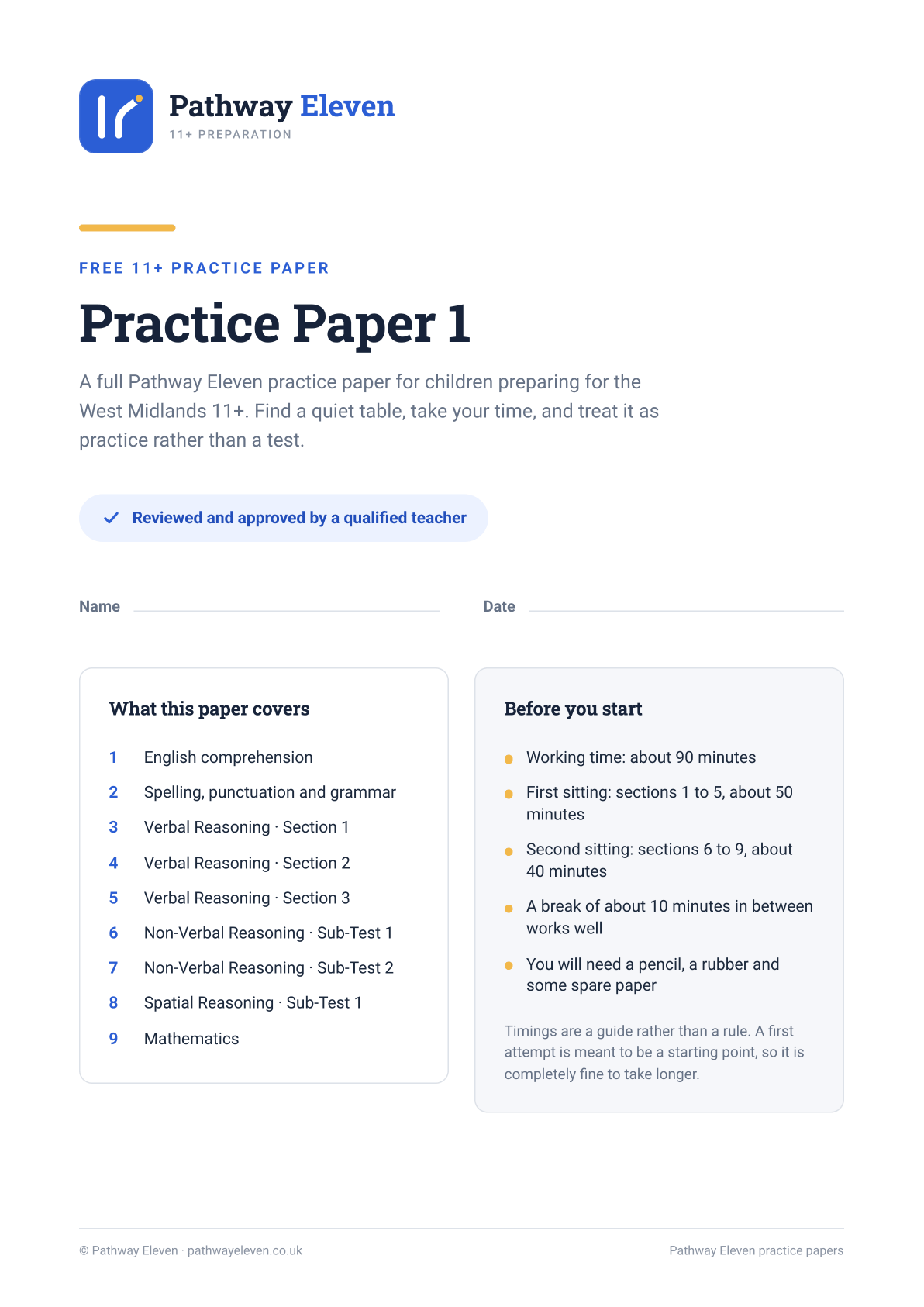
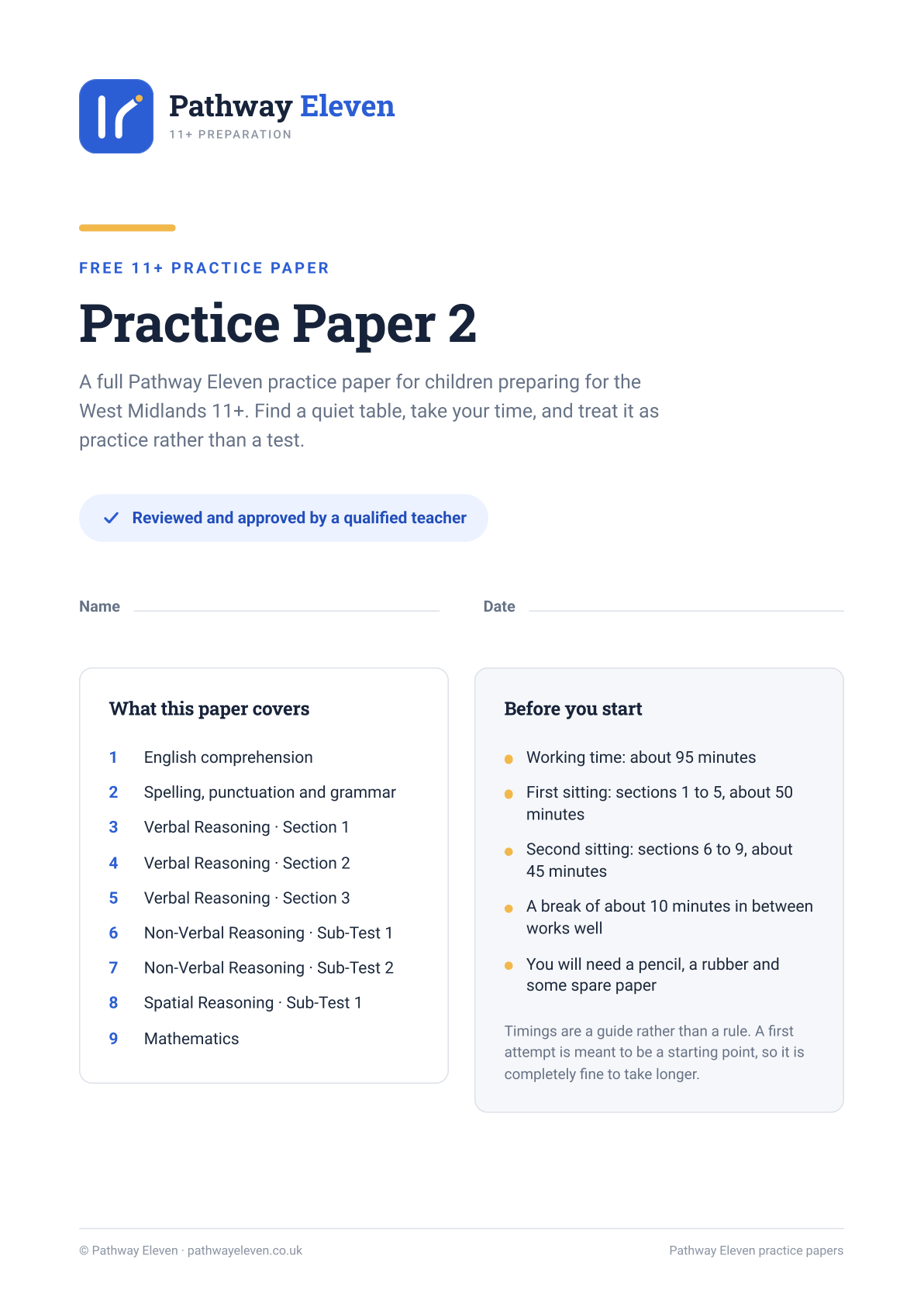
- Two complete papers in the published format
- Answer sheets and worked answers
- Sent to your inbox in a minute
Both papers carry a complete mathematics section, timed on its own.
Check your inbox
We have sent a confirmation link to the address you gave. Your practice paper pack arrives as soon as you confirm.
Not there in a minute? Check spam/promotions. If it still has not arrived, email info@pathwayeleven.co.uk and we will send it again.
Check your inbox
Your practice paper pack is on its way to the address you gave. It arrives as a link, so you can open it on whichever device you would rather print from.
Not there in a minute? Check spam/promotions. If it still has not arrived, email info@pathwayeleven.co.uk and we will send it again.
Written and reviewed by a qualified teacher, for the West Midlands exam.
Your first name and address are used only for these emails. Privacy Notice.
Which maths topics come up most, and which are worth drilling?
The mathematics on this paper samples the primary curriculum. The complication is the calendar. The test is sat at the start of Year 6, and the national curriculum places ratio and proportion in Year 6 itself, so that family of questions covers content a child will not have been taught in school yet. Percentages are a different case: they are Year 5 content, met in the year before the test, so they are usually recent rather than absent and need securing early rather than teaching from scratch. Meeting both ahead of the timetable is a large part of what preparation is for, and a gap there is the calendar's fault rather than your child's.
| Topic family | What a question looks like | First taught |
|---|---|---|
| Number and place value | Rounding, ordering, negative numbers, Roman numerals. | Year 4 and Year 5 |
| Four operations | Multi-digit multiplication and division, factors, multiples, primes, squares. | Year 5 |
| Fractions, decimals and percentages | A fraction or a percentage of an amount, converting between the three forms. | Year 5 |
| Ratio and proportion | Sharing in a ratio, scaling a recipe, a difference given rather than a total. | Year 6 |
| Algebra | A missing number in a rule, a simple formula in words. | Year 6 |
| Measurement, time and money | Unit conversion, durations across the hour, change from a note. | Year 4 and Year 5 |
| Geometry and shape | Perimeter, area, angles, properties of shapes, coordinates. | Year 5 |
| Statistics | The mean, reading a table or a line graph. | Year 5 and Year 6 |
Two rows in that table are the reason preparation exists at all. Ratio and proportion and algebra are Year 6 content sat at the start of Year 6, so a child meets them for the first time in a test unless somebody gets there first. Source: national curriculum in England, mathematics programmes of study, checked 6 September 2026.
The families that reward drilling, in the order we would take them:
- Number facts to instant recall. A child working out seven eights has spent their thinking on the wrong part of the problem.
- Fractions, decimals and percentages as one topic. Questions move between the three forms freely, and a child who can convert quickly answers a whole family of questions with one skill.
- Ratio and proportion. A frequent source of lost marks at this level in our own marking, largely because a part is confused with a total.
- Two-step word problems. Not harder mathematics, more of it, held in the head at once.
- Measure, time and money. Cheap marks, easily lost to unit slips.
- Averages, area and perimeter. Small topics with fixed methods, worth securing because they never get harder.
A deeper checklist of every topic, with the ones parents most often skip, is on our 11 plus maths topics page, and 11 plus maths explained covers how the subject develops from Year 3 onwards.
How should a child practise maths papers at home?
Short and often beats long and occasional, and the reason is specific to this format. A section here is short and separately timed, so the skill being built is choosing a method fast and committing to it. A long unhurried session builds a different skill, and a good one, but not that one.
Three rules we would hold to. Time the section rather than the question, so a child learns to leave one and come back. Use a separate answer sheet every time, because transferring answers is a real source of lost marks and it is free to practise. And when a question is wrong, ask your child to explain what they did before you say anything, because the explanation usually contains the diagnosis.
Whole papers belong in the picture too, occasionally rather than weekly. Our page on 11 plus past papers explains why no released paper exists for this test and what a good practice paper does instead, and how much 11 plus practice a day sets out how to settle on a rhythm.
Questions parents ask about 11 plus maths papers
How much of the 11 plus is maths?+
The consortium publishes the weighting as 50% for English and verbal reasoning together, 25% for non-verbal reasoning and 25% for mathematics. So mathematics is a quarter of the result, which is less than the share of preparation time we usually see it given.
Is a calculator allowed?+
No calculator is provided or expected, and none of the published descriptions of this test mentions one. Check the test information your allocated centre sends for the current cycle rather than relying on any website, including this one.
Are 11 plus maths papers harder than school maths?+
The content is primary mathematics, but the test falls at the start of Year 6, so ratio and proportion, which the national curriculum places in Year 6, will not have been taught in school yet. Percentages are Year 5 content, so they have usually been met but not yet secured. The pace is also faster than a classroom lesson, and there are no method marks.
My child is good at maths but slow. What should we practise?+
Timed sections rather than more questions, and the habit of leaving a question and coming back. Speed at this level comes mostly from instant number facts and from choosing the simpler order of operations, both of which respond quickly to short daily work.
How many maths papers should my child complete?+
Far fewer than the internet suggests. Complete papers are for measuring, so one every few weeks, with the weeks in between spent on whatever the last one exposed, does more than a paper a week. Short timed sections are the daily work, and the rhythm that suits your own child matters more than any published number.
Do these sample questions come from a real paper?+
No. They were written for this page by Pathway Eleven. No past paper for this test is published by anybody, and any site offering one is offering a reconstruction.
Where to go next
- 11 plus past papers, what exists for this test and what to use instead.
- 11 plus maths explained, the subject from Year 3 to the test.
- 11 plus maths topics: a checklist, every topic worth covering.
- 11 plus English papers, the comprehension section with worked questions.
- 11 plus verbal reasoning papers, the question types worked through.
- Download a sample paper with answers, two full papers with their mark schemes.
- 11 plus mock tests online, a full paper marked on submission.
- What a subscription costs, one plan, every subject.
The Starting Assessment covers all four areas, and the plan gives most of its time to whichever is weakest.
Where the maths facts come from, and what is ours
The sample questions above are Pathway Eleven's own. Every statement about the test itself was read at its published address on 6 September 2026. Pathway Eleven is an independent service and is not affiliated with or endorsed by GL Assessment.
- West Midlands Grammar Schools, the entrance test, the individually timed sections, the multiple-choice answer sheet and the weighting. Checked 6 September 2026.
- Warwickshire County Council, the 11 plus test, the four sections, the multiple-choice format and the around-sixty-minutes figure. Checked 6 September 2026.
- King Edward VI Foundation, entrance test information, that question booklets are not marked and only the separate answer sheets are. Checked 6 September 2026.
- GL Assessment, free 11 plus materials, the free familiarisation papers and the printed practice booklets, including maths. Checked 6 September 2026.