Every Year 6 family applies for a secondary school place through the council they pay council tax to, on one common application form, by 31 October. One offer arrives on 1 March. The selective test is a separate registration, and it is one route among several. Eleven councils run the form here.
Who do you apply to, and by when?
You apply to the council you pay council tax to. Not to the schools, and not to the council the school happens to sit in. GOV.UK puts it in one line: you apply through your local council even if you are applying for schools in another council area. A family in Great Barr naming a school in Walsall still applies to Birmingham, on the Birmingham form, and the two councils sort it out between them.
One form covers every school you name. There is no second form for a school across a boundary, and no separate form for an academy. What there sometimes is, and what catches families out every year, is a supplementary information form that a faith school or an academy asks you to send directly to the school, or to the local authority, whichever its own form says. Birmingham warns that failing to do this may mean your child's application is assessed under a lower criterion. The council application is still required as well.
The national deadline is 31 October, and it is the same in all eleven areas below. What differs is when the form opens, how many schools you may name, and the exact closing time.
One thing about this cycle is worth planning around: 31 October 2026 is a Saturday. The closing times below still stand, and several of them fall late in the evening, but a council switchboard is not open on a Saturday and a portal helpline usually is not either. If the form errors at 11pm there is nobody to call. Submit on a weekday, and treat the Saturday as the day the door closes rather than the day you use.
| Council | Form opens | On-time deadline | Schools you may name |
|---|---|---|---|
| Birmingham | 9:00am, 1 September 2026 | 11:59pm, 31 October 2026 | Up to 6 |
| Walsall | 11 September 2026 | 10pm, 31 October 2026 | Advises 5 |
| Wolverhampton | 10 September 2026 | 31 October 2026 | Up to 5 |
| Sandwell | Not stated on that page | Not stated on that page | Not stated on that page |
| Dudley | 1 September 2026 | Midnight, 31 October 2026 online; 5pm on paper | Up to 6 |
| Solihull | Not stated in the scheme | 31 October 2026 | 6 |
| Coventry | 1 September 2026 | 31 October 2026 | Three |
| Warwickshire | 1 September 2026 | 4:00pm, 31 October 2026 | Not stated on that page |
| Shropshire | 1 September 2026 | 31 October 2026 | Not stated on that page |
| Telford and Wrekin | Not stated on that page | 31 October 2026 | Advises 4 |
| Staffordshire | 1 September 2026 | 31 October 2026 | Not stated on that page |
Two rows need a word of explanation rather than a guess. Sandwell publishes its offer day for 2027 entry and carries a live link to apply online, but on 7 September 2026 its applying page still described the round that closed in October 2025 and did not state an opening date, a closing time or a preference count for the current one, so none is printed here. Warwickshire, Shropshire and Staffordshire state a deadline but not a maximum number of preferences on the page linked above, so no number is printed for them either. In every case the council's own page is the thing to open, and it is linked in the first column.
Your council, in one sentence
The same eleven rows written out, one sentence each, so that a school newsletter or a school website can link the paragraph its own families need. Every sentence below is the council's own published position, read on 7 September 2026, and the council's page is linked from its name in the table above.
- Birmingham. Birmingham's application for entry in September 2027 opened at 9:00am on 1 September 2026 and closes at 11:59pm on 31 October 2026, you may list up to 6 secondary schools in order of preference, and the council expects to email offers by 4:00pm on Monday 1 March 2027.
- Walsall. Walsall's on-time application portal is open from 11 September 2026 until 10pm on 31 October 2026, and the council says you should include five schools on your application, listed in order of preference.
- Wolverhampton. Wolverhampton opens online applications on 10 September 2026 with a deadline of 31 October 2026, lets you list up to five schools as your preferences, and publishes 1 March 2027 as allocation day.
- Sandwell. Sandwell publishes Monday 1 March 2027 as offer day for secondary school places; on 7 September 2026 its applying page had not yet stated the opening date, the closing time or the number of preferences for entry in September 2027, so open that page before you rely on any figure.
- Dudley. Dudley closes online applications at midnight on 31 October 2026 and paper forms at 5pm the same day, accepts up to 6 preferences, and sends decision emails by 2pm on 1 March 2027.
- Solihull. Solihull's qualifying scheme for 2027 to 2028 sets the number of preferences at 6, the closing date at 31 October 2026 and offer day at 01 March 2027. The Solihull 11 plus, the borough with no grammar school of its own and the two registrations its families meet.
- Coventry. Coventry's application process opens on 1 September 2026 and closes on 31 October 2026, and the city's Secondary School Co-ordinated Admissions Scheme 2027/28 sets three preferences at paragraph 4.2, in rank order. The council separately advises that one of the three should be your catchment area school, which is advice rather than the count. How a Coventry application is different sets out what those three preferences mean for a family aiming at a selective school in another area.
- Warwickshire. Warwickshire opens on 1 September 2026 and sets its deadline at 4.00pm on 31 October 2026, with national offer day on 1 March 2027; the page does not state a maximum number of preferences.
- Shropshire. Shropshire's online facility is open from 1 September 2026, applications must be made by 31 October 2026, and the council gives national offer day for secondary schools as 1 March 2027.
- Telford and Wrekin. Telford and Wrekin closes Year 7 applications on 31 October 2026, uses the same closing date for a child with an Education, Health and Care plan, and strongly advises applying to four local schools including your nearest or catchment area school.
- Staffordshire. Staffordshire opens applications on 1 September 2026, closes them on the national closing date of 31 October 2026, and makes offers on national offer day, 1 March 2027.
Every council in this table shares the same national deadline. GOV.UK states that applications usually open on 1 September and that you must apply for a secondary school place by 31 October, with offers sent on 1 March. A council that publishes nothing else still works to those two dates.
How do preferences actually work?
This is the part of the process that is easiest to misread, and it is worth getting right, because misreading it is what produces the offer nobody wanted.
Councils in England run an equal preference system. Dudley states it in one sentence: it considers all applications at the same time, and priority is not given to those who put the school as a first preference, or on a first come first served basis. Every school you name looks at your child as if you had named it first, applies its own oversubscription rules, and says yes or no.
Your ranking is used at exactly one moment, and only then. Solihull's published scheme says what that moment is: with a system of equal preferences it is possible that more than one school may be allocated, and in that event a place will be offered at the one highest ranked school which could be allocated. So the order decides which of your yes answers becomes the offer. It never persuades a school to say yes.
Three things follow, and they are the practical content of this section.
- Ranking a school lower costs you nothing. Put the schools in the order you actually want them, including one you think is a long shot. It cannot displace anything below it.
- Naming fewer schools gains you nothing. GOV.UK states that listing only one school will not increase your chances of getting a place there. It only increases the chance that none of your preferences works out.
- At least one name has to be realistic. Birmingham publishes worked examples of exactly this failure: a child who was named at six schools, met the criteria at none of them, and was offered a school two and a half kilometres away, when the school 500 metres from home would have taken him if the family had listed it. Nothing in the system fixes an unrealistic list.
What makes a name realistic is the school's own oversubscription criteria, and those are published. Sibling links, distance, and for many schools a defined catchment or priority area. Distance is measured by the council rather than by you: Birmingham publishes that it calculates a straight line in metres between the home address and an agreed point at the school site, from ordnance survey coordinates, that this takes no account of walking, cycling or driving routes, and that other websites offering distance measurements will produce different figures. Because the measurement is applied afresh to whoever applies in a given year, the furthest distance offered last year is a guide and not a threshold you can rely on.
Catchment areas are a priority, not a guarantee, and Coventry publishes the distinction in the plainest form in the region: if you live within a school catchment area you have more chance of your child being offered a place at that school, but living within the catchment area does not guarantee a place, as there may be more applicants than available places to allocate. Coventry, Telford and Wrekin and Shropshire all use catchment language on the pages linked in the table above, and each of them defines it its own way, so read the definition on your own council's page rather than assuming the one next door applies.
Which kinds of school can you name, and where does the grammar route fit?
All of them go on the same form, in the same list, ranked against each other. What changes between them is who decides, and on what.
- Community and voluntary controlled schools. The council is the admission authority. Its published criteria decide, and the council applies them.
- Academies and free schools. Each is its own admission authority. It sets its own criteria and publishes them, and the council still collects your preference and passes it on. Solihull's scheme describes exactly this handover: preferences for own-admission-authority schools are passed to them, and they say whether a place can be offered.
- Faith schools. Also usually their own admission authority, and commonly the schools that ask for a supplementary information form with evidence of practice. Birmingham's worked examples include a child refused at two Catholic schools because he was not a baptised, practising Catholic and did not attend a Catholic feeder primary. That is not a surprise if you read the criteria; it is a shock if you do not.
- Selective schools. On the same form, ranked with the rest, but with an extra condition attached: a qualifying test score, earned months earlier.
- Independent schools. Not on the form at all. GOV.UK is direct about it: if you are looking for a place at a private school, contact the school directly. An independent offer does not remove your right to a state place, and it does not remove your right to appeal for one.
The selective route, in the two sentences that matter. Registering for the test is not applying for a school. It is a separate registration, made in the summer term of Year 5, to the shared consortium portal or to Warwickshire's own portal, and it closes months before the council form opens; the closing dates are on our registration guide, linked at the end of this section. If you want a selective school considered, you must also name it on the council form by 31 October, like any other school.
Birmingham's timetable for this cycle sets the sequence out plainly: the grammar school test on 12 September 2026, results received by 31 October 2026, and the application closing date on 31 October 2026. The council's own advice is not to submit until you have the score, and its worked examples show why: one family applied before results arrived and ranked the grammar schools below the local schools, so the local offer came out on top even though the child had scored well enough. The order you set is the order that gets used.
The mechanics of that registration, its two portals and its closing times are on our registration guide; the test and results dates are on the West Midlands 11 plus dates page, which also publishes a calendar file; and what the score means when it arrives is on the results page and in the per-school results tracker. None of that is repeated here. This page is about the council year that runs alongside it.
What changes if your child has an EHCP, or is in care?
Two groups of children move through a different door, and both are easy to miss on a council's main applying page because both are usually described somewhere else.
An Education, Health and Care plan takes your child off the common application form. Birmingham says so directly: do not use this form if your child has an EHCP, and go to the Phase Transfer pages on the Local Offer website instead. That 15 February date is national rather than local: the SEND code of practice states at paragraph 9.179 that the review and any amendments must be completed by 15 February in the calendar year of the transfer at the latest, and it names primary school to secondary school as one of the key transfers. Warwickshire publishes the same date in its own timetable, and asks for preferred choices through its parents and carers portal from 1 September. Telford and Wrekin runs EHCP applications to the same 31 October closing date as everybody else.
A child on SEN support, with no plan, applies on the ordinary form, and the extra work is a conversation rather than a different route. Warwickshire runs one transition timeline for children with an EHCP and children who need SEN support together, and it asks that where a child needs SEN support, or is still waiting for an assessment to be agreed, a transition planning meeting between the feeder school, the receiving school and the family has taken place by the first week of October. That is a Year 5 and early-autumn conversation with the primary school's SENCo, not something the council application form has a box for.
The reason the timetable is different is that the school has to be consulted before it is named, and once it is named the position is stronger than any preference. GOV.UK states it in a single line: a school named in the EHC plan must give your child a place. That is a duty on the school rather than a preference the council weighs, which is why the EHCP timetable runs on its own dates.
If your child has an EHCP, the practical instruction is short. Talk to the SEND caseworker in the summer term of Year 5, not in the autumn of Year 6, because the annual review is where the secondary conversation belongs, and the consultation with the school runs from there.
Looked-after children come first in the criteria, everywhere. That is not a local choice: the School Admissions Code, published by the Department for Education and binding on every admission authority in England, requires that highest priority in the oversubscription criteria goes to looked after children and previously looked after children, including children who were looked after and then became subject to an adoption, child arrangements or special guardianship order. Previously looked after counts for the same priority as currently looked after. It is not applied automatically, though: it has to be declared on the form, with evidence, so that the schools you name can see it.
Pupil premium is a different thing again, and it is worth separating. On the council application it is not a priority in itself. On the selective test registration it can be, and it is a box on that earlier form: our registration guide sets out what Birmingham City Council publishes about it, including its warning that you cannot apply under pupil premium if you forget to tick it.
Check this first: the SEND route is run by a named team, not by the admissions inbox. Find your council's SEND or Local Offer pages and speak to them by name. Councils publish the SEND timetable separately from the admissions timetable, and several of them publish it on a separate Local Offer site altogether, so a phone call to the named team is quicker than a search. Telford and Wrekin, for instance, publishes its Local Offer at telfordsend.org.uk rather than on the council site.
Pathway Eleven is independent of every council, school, consortium and admissions authority named on this page. We cannot make an application, check one, or tell you what a council will decide.
National offer day: what happens on Monday 1 March 2027, and in the weeks after it
National offer day for secondary schools is Monday 1 March 2027, and every council in the table publishes that date. Some publish a time as well: Birmingham expects its offer email to arrive by 4:00pm, and Dudley sends its decision emails by 2:00pm. You receive one offer, not a list, because the equal preference system has already resolved your ranking down to a single school.
It does not move this year, and it is worth saying why, because it moved last year. GOV.UK publishes the rule: councils send secondary offers on 1 March, and if that date falls on a weekend or a bank holiday the offers are sent on the next working day instead. 1 March 2027 is a Monday, so the date stands. For entry in September 2026 it did not: 1 March 2026 fell on a Sunday, and Birmingham's own offers page for that cycle was headed Offers - 2 March 2026 and told families they would be emailed on Monday 2 March 2026. A family that went through last year's round and is expecting the same slip this year will be a day early.
If none of your named schools could take your child, the council must still offer a place somewhere. GOV.UK states the duty plainly: the local council must provide a place at another school if your child is not offered a place at any of the schools you have applied for. It is usually the nearest school with a vacancy, which is why the realistic name on the list matters so much.
Waiting lists
The thing to know first is that a waiting list is not a queue. GOV.UK requires the admission authority to keep one open for at least the first term of the school year, and adds that you can put your child's name down even if they have already been offered and started somewhere else.
Some of it happens without you asking, and some of it does not. Three of the councils here place a child on the higher-preference lists automatically. Birmingham states that if you do not receive an offer at your higher preferred Birmingham schools, your child's name will automatically be placed on the waiting lists for those schools. Warwickshire states that if you have not been offered your first preference, you will automatically be placed on the waiting list for your higher preference schools. Walsall states that where it cannot meet your preferences it will also put your child's name on the waiting list for your preferred schools. For a school you ranked below the one you were offered, or a school you never named at all, nothing is automatic anywhere: you have to ask, and in Birmingham a school you did not name needs a late change of preferences form rather than a phone call.
One exception matters if the selective route is one of yours. Birmingham's automatic placement does not apply to the Birmingham grammar schools: the council states that a child must have achieved the qualifying score of 205 to be included on a grammar school waiting list at all. A score below it does not go on the list and then wait.
The order is the school's oversubscription criteria, re-applied every time the list changes. Birmingham is explicit that late applicants are added in that same order, so your child's name can move down as well as up. Councils also publish when the list becomes readable: Birmingham makes waiting list positions available from 22 March 2027, Walsall from 17 March 2027, Warwickshire from 15 March, and Dudley runs its lists until 31 August before a family has to reapply. Birmingham adds a rule worth knowing before it happens: if a better offer arrives from a waiting list and you would rather keep the place you already hold, you have 7 days to say so, or the original offer is withdrawn automatically.
Refusing the offer is the one move with a cost. Dudley publishes it plainly: all refusals must be in writing, and if you refuse the school offered, consider that this school may not be available at a later stage. Dudley adds the other half in the same breath, and it is the reason to accept: accepting the place will not affect any waiting list position, and is not prejudicial to any appeal you lodge.
Appeals
You can appeal a refusal at a school on your application, and accepting the place you were offered does not weaken the appeal. Which refusals you may appeal is set by each council, and the two that publish it here publish it differently. Birmingham states that you can only appeal against the refusal of a place at a school that is currently one of your live preferences. Warwickshire states that you can appeal for any higher preference school for which you have been refused a place. Check the wording your own council uses before you assume a refusal is appealable.
The national rules are published by the Department for Education: you must be allowed at least 20 school days to write and send your appeal, and at least 10 school days' notice of the hearing.
The panel is not the school's. Birmingham states that appeals are heard and decided by panels that are completely independent of the school's admission authority, and Warwickshire that appeals are heard by independent appeal panels. The people deciding are not the people who refused.
Each council then sets its own dates. Birmingham closes written appeals on 13 April 2027 and hears on-time appeals on 16 June 2027; Warwickshire closes on 12 April 2027 with hearings from May to July; Dudley lodges in April and hears from May to July, and warns that appeals received after its deadline may not be heard until mid September onwards; Staffordshire hears from May to July.
It is worth being honest about the odds, and the councils are. Birmingham publishes its own record: 422 secondary transfer appeals heard in 2025 with 4% successful, 476 in 2024 with 3.9%, and 427 in 2023 with 6%. Dudley publishes its own in raw numbers: 127 heard in 2026 with 6 allowed, 101 in 2025 with 6 allowed, and 115 in 2024 with 20 allowed. Appeals succeed on a specific, evidenced case about your child, not on how much a family wants the school. Our results tracker carries the per-school appeal figures for the selective schools alongside their scores.
Will the council pay for the journey?
Sometimes, and the rule is national. GOV.UK sets the statutory walking distances: a child of compulsory school age qualifies for free school transport if they go to their nearest suitable school and it is more than 2 miles away and the child is under 8, or more than 3 miles away and the child is 8 or over. Birmingham prints the same two figures in its own qualifying distance table, though it labels the boundary "up to 8 years old" and "over 8 years old" where GOV.UK writes "under 8" and "8 or over".
Distance is not the only door. GOV.UK lists two grounds that do not depend on it at all: where there is no safe walking route between home and school, and where a child cannot walk there because of their special educational needs or disabilities or a mobility problem. Neither is judged by the mileage, and the second is worth raising with the SEND team rather than with admissions.
There is one exclusion that decides most Year 6 cases, and Birmingham states it without softening: you cannot get a pass if your child goes to a school further than the qualifying distance because that is the school you want, when they could have gone to a school within that distance. Choosing a school further away is a choice the council does not fund.
Low-income families have wider rights, and they are national rights, not a local council's generosity. GOV.UK states that a child may also qualify for free school transport if they are eligible for free school meals, and that from the start of the 2026 to 2027 academic year a child continues to be eligible where the household gets Universal Credit and has an income of £7,400 a year or less after tax and not counting benefits. On that basis GOV.UK publishes three bands, and every council in this table works to them:
- aged 8 to 11, going to the nearest school, where it is at least 2 miles away. This is the band a Year 6 child is in for the journey they are making now.
- aged 11 to 16, going to a school 2 to 6 miles away, if it is one of their 3 nearest suitable schools.
- aged 11 to 16, going to a school 2 to 15 miles away, if it is one chosen because of your religion or belief.
Councils restate those bands in their own policies, sometimes in different words: Wolverhampton's home to school travel policy sets out the same three-nearest 2 to 6 mile entitlement and the same 2 to 15 mile religion or belief entitlement alongside its general three-mile rule. If your own council's policy is silent on a band, the national entitlement is still the entitlement; the council page is where you apply, not where the right comes from.
Two practical notes. Applications have their own deadlines, separate from the school one: Shropshire asks for transport applications by 31 May for autumn term travel. And a refusal can be challenged, on its own timetable: Coventry gives 28 calendar days from the refusal letter.
What should a family do in each month?
The year has four moments that cannot be moved and a great deal of quiet space between them. This is the whole of it, from the summer before Year 6 to the spring inside it.
| When | What is happening | What a family does |
|---|---|---|
| Summer term, Year 5 | Selective test registration opens and closes. EHCP annual reviews run. | Decide whether to register for the test, and register if so. If your child has an EHCP, raise secondary schools at the annual review. |
| September | The council form opens, on 1 September in most of the region. Open evenings begin. | Visit schools. Read the oversubscription criteria for each one, not the prospectus. Check which schools want a supplementary form. |
| October | Selective test results arrive. The deadline falls on 31 October. | Rank the schools you actually want, longest shot first, with at least one realistic name. Submit, and re-submit if you change anything. Send supplementary forms where each school's own form says, which is direct to the school or to the local authority. |
| November and December | Councils process on-time applications. Moving-house windows close. | Nothing, unless you move, or unless you missed 31 October. Warwickshire and Coventry take address changes until 31 December 2026 and Dudley wants proof by 12 February 2027. If you were late, apply now anyway: Walsall publishes a window from 1 to 27 November 2026 in which a late application may still be considered as on time, but only in exceptional circumstances, and treats everything from 28 November as late. |
| January and February | Allocation runs. EHCP consultations conclude. | Nothing on the ordinary route. On the EHCP route, expect the final plan naming a setting by 15 February: the SEND code of practice sets that date nationally, and Warwickshire publishes it in its own transition timetable. |
| 1 March | National offer day. One offer per child. | Read the letter or email. Accept the place even if you intend to appeal, because accepting costs you nothing. |
| March and April | Waiting lists open and appeal deadlines fall. | Check which waiting lists you are already on: higher preferences are automatic in Birmingham, Walsall and Warwickshire. Ask for any lower preference or unnamed school. Lodge an appeal in writing by your council's date, with the specific case for your child. |
| May to July | Appeal panels sit. Lists move as families decline places. | Attend the hearing. Keep checking the waiting list. Apply for transport if you need it. |
The one-page checklist
Everything above, on one sheet, in the order it happens. There is no form to fill in and no address to give: press the button, or use your browser's own print command, and only the sheet prints.
Secondary transfer checklist, entry September 2027
Your council
Form opens Closes
Schools you may name
- Find your own council's applying page. It is the council you pay council tax to, whichever council the schools sit in.
- Write down your council's opening date, its closing time on 31 October 2026, and how many schools you may name.
- Read the oversubscription criteria for every school you are considering, not the prospectus.
- Check which of those schools wants a supplementary information form, and send it where that form says, which is direct to the school or to the local authority.
- If your child has an EHCP, contact the SEND team rather than admissions. The SEND code of practice requires the plan to be reviewed, amended and issued by 15 February 2027.
- If your child is looked after or previously looked after, declare it on the form with evidence.
- If you registered for the selective test, wait for the score, then rank the selective schools where you truly want them.
- Rank every school in your real order. Include at least one you would realistically be offered.
- Submit before the deadline, and re-submit after any change, or the change is not counted.
- Tell your council straight away if you move house, and check its extended address deadline.
- On 1 March 2027, accept the offer. Accepting does not weaken a waiting list place or an appeal.
- Check which waiting lists you are on automatically, and ask to join the list for any other school you would still prefer.
- Lodge any appeal in writing by your council's date, with the specific reasons for your child.
- Check whether you qualify for free school travel, and apply by your council's transport deadline.
Checked 7 September 2026, for entry September 2027. Written by Pathway Eleven and free to print, copy and hand out. Every date on it is your council's, so open your council's page before you rely on any of it. pathwayeleven.co.uk/secondary-transfer-west-midlands/
For schools and school offices
This page exists to be linked. Everything a family needs is on it, free, with no gate and no sign-up. In plain terms: Pathway Eleven is a paid 11 plus preparation service. This page is free, it has no gate, and it carries two links to a free account and one optional email form, all of them below the checklist. Nothing above the checklist sells anything. The only other places we name ourselves above it are the byline at the top, the links to our own free guides on the test itself, and the line in the SEND section saying that we are independent of every council, school, consortium and admissions authority named on this page. We point at the councils rather than at ourselves.
If it is useful to your families, put it on your secondary transfer or useful websites page. You are welcome to print the checklist for a transition evening, or to copy it into your own newsletter, as long as the source is credited. The checklist prints on one sheet of A4 on its own: the rest of the page, the navigation and both of those product mentions are suppressed on paper, so a photocopy for ninety families is a photocopy of the checklist and nothing else.
A link that works anywhere:
<a href="https://pathwayeleven.co.uk/secondary-transfer-west-midlands/">Secondary transfer in the West Midlands: the whole Year 6 year</a>If your site's or your trust's policy requires outbound links to be nofollowed, this version works just as well for us:
<a href="https://pathwayeleven.co.uk/secondary-transfer-west-midlands/" rel="nofollow">Secondary transfer in the West Midlands: the whole Year 6 year</a>To send families straight to their own council's answer, add the anchor: #walsall, #birmingham, #coventry and so on, or #checklist for the printable sheet.
If a date on this page is wrong for your area, or your council publishes something we have missed, tell us at info@pathwayeleven.co.uk and we will check it against the council's own page and correct it.
This page is about the paperwork, and the paperwork is only ever half of Year 6. If your family is also preparing for a selective test, create a free account and see where your child stands before you decide anything. Every question in the bank is reviewed and approved by a qualified teacher before it reaches a child.
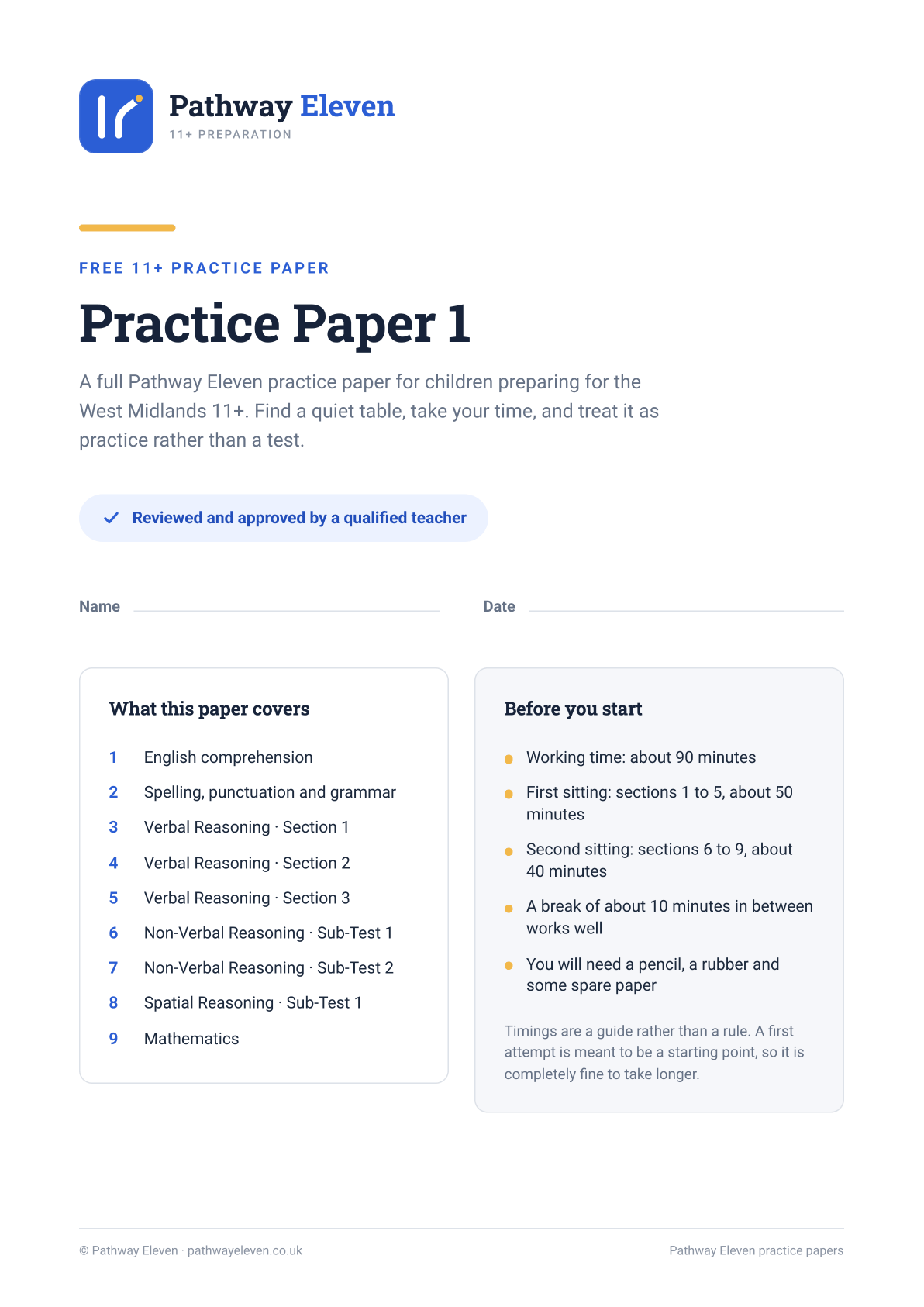
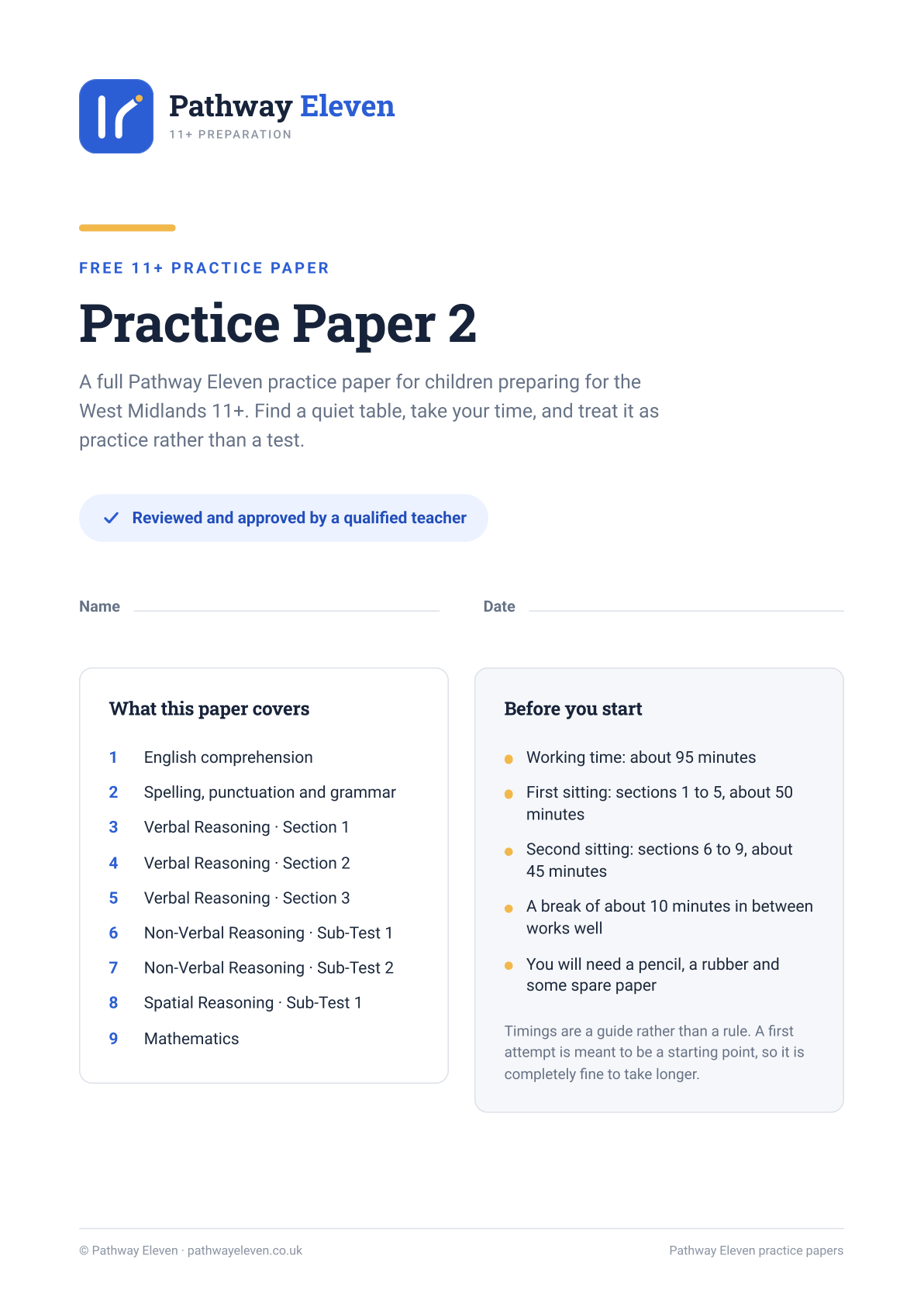
- Two complete papers in the published format
- Answer sheets and worked answers
- Sent to your inbox in a minute
Wondering how ready your child actually is? Start with two papers and find out.
Check your inbox
We have sent a confirmation link to the address you gave. Your practice paper pack arrives as soon as you confirm.
Not there in a minute? Check spam/promotions. If it still has not arrived, email info@pathwayeleven.co.uk and we will send it again.
Check your inbox
Your practice paper pack is on its way to the address you gave. It arrives as a link, so you can open it on whichever device you would rather print from.
Not there in a minute? Check spam/promotions. If it still has not arrived, email info@pathwayeleven.co.uk and we will send it again.
Written and reviewed by a qualified teacher, for the West Midlands exam.
Your first name and address are used only for these emails. Privacy Notice.
Common questions about secondary transfer
Who do you apply to for a secondary school place?+
The council you pay council tax to, even when the schools you want are in another council area. GOV.UK states that you apply through your local council even if you are applying for schools in another council area. One form covers every school you name, including schools across a borough boundary.
Does putting a school first make you more likely to get it?+
No. Every council in England runs an equal preference system. Dudley states it plainly: we consider all applications at the same time, priority is not given to those who put the school as a first preference, or on a first come first served basis. Your ranking is used only to decide which single offer you get when more than one school could take your child.
What happens if you miss the 31 October deadline?+
Your application is treated as late. Birmingham states that a late application will not be processed until after the offer of places on 1 March 2027, and Coventry that late applications will be considered in the second allocation round in April 2027. You do not lose your right to a place, because the council must still offer one, but the popular schools will usually be full.
How many schools should you put on the form?+
As many realistic ones as your council allows, and the region publishes it two different ways. Birmingham, Dudley and Solihull set a maximum of six, and Wolverhampton five. Coventry's co-ordinated scheme sets three preferences at paragraph 4.2, and separately advises that one of them should be your catchment area school; Walsall publishes advice rather than a cap and says you should include five. GOV.UK states that listing only one school will not increase your chances of getting a place there.
Does the application change if your child has an EHCP?+
Yes, and it usually leaves the common application form entirely. Birmingham tells parents not to use the online form and to go to the Phase Transfer pages instead. Warwickshire asks for preferences through its own portal from 1 September and issues the final plan naming a setting on or before 15 February. GOV.UK states that a school named in the EHC plan must give your child a place.
Is the grammar school test part of the council application?+
No. It is a separate registration, made in the summer term of Year 5 to the consortium or to Warwickshire, and it closes months before the council form opens. Registering for the test is not an application for a place. If you want a selective school considered, you must also name it on the council form by 31 October.
When is national offer day 2027?+
Monday 1 March 2027. GOV.UK states that councils send secondary school offers on 1 March, and that if the date falls on a weekend or a bank holiday the offers are sent the next working day instead. 1 March 2027 is a Monday, so it does not move. It did move in the cycle before this one: 1 March 2026 fell on a Sunday, and Birmingham's own offers page for that year was headed Offers - 2 March 2026.
When do waiting lists and appeals happen?+
After offer day, and each council publishes its own dates. Birmingham opens waiting list positions on 22 March 2027 and closes written appeals on 13 April 2027, with on-time hearings on 16 June 2027. Warwickshire publishes waiting list positions on 15 March and closes appeals on 12 April 2027. GOV.UK states that a waiting list must be kept open for at least the first term of the school year.
Where to read next
- Which grammar schools can my child apply to, from my postcode, the nineteen partnership schools in distance order from a postcode, each with its catchment or priority area in its own words.
- West Midlands 11 plus dates and deadlines, every published test date for the current cycle, each one sourced, with a calendar file.
- How to register for the West Midlands 11 plus, the two portals, the closing times and the boxes that cannot be fixed later.
- West Midlands 11 plus results, what the score means and what a family does next.
- The results tracker, per-school scores and appeal figures in one table.
- What is the 11 plus?, for a family deciding whether the selective route is for them at all.
- Birmingham, Walsall, Wolverhampton, Warwickshire and Shropshire and Telford, the selective schools in each area and their published cycle.
- 11 plus preparation in Year 5, the year in which the separate test registration falls.
- 11 plus information a primary school can pass to parents, a newsletter paragraph, a link line and a printable A4 leaflet, all free and ungated.
- All 11 plus guides for parents, everything we have written, in one list.
A Starting Assessment, then daily work weighted towards whichever area your child needs most.
Every council and government page cited above, with the date it was read
Thirty addresses, each opened and read in full on 7 September 2026. Where a council publishes a figure and a neighbour does not, both are recorded as they were found rather than one standing in for the other. Where a page had not been updated for the current round, that is said above rather than smoothed over. No fact on this page is welded from two sources: each one is attributed to the single page it came from.
Sandwell, Staffordshire and Telford and Wrekin publish their SEND information on separate Local Offer directories rather than on the admissions pages above. Telford and Wrekin's opened and is cited below; the other two did not respond to the requests made on 7 September 2026, so no SEND date is attributed to those two councils anywhere on this page. Phone the named SEND team rather than relying on any of these pages.
How this page is kept current. Every page in this list is re-read once a term. The next check is December 2026, and the "last updated" date at the top of this page moves only when something on the page actually changes.
- GOV.UK, School admissions: how to apply, the national deadline, the 1 March offer date, the rule that moves it off a weekend or bank holiday, the duty to offer a place, and the rule that listing one school helps nobody.
- GOV.UK, School waiting lists, the duty to keep a list for at least the first term.
- GOV.UK, School admissions: choosing schools, the EHC plan naming rule and the route to independent schools.
- Department for Education, advice on school admission appeals, the 20 school days to lodge and 10 school days' notice of a hearing.
- GOV.UK, Free school transport, the 2 mile and 3 mile statutory distances, the unsafe-route and SEND grounds, the free school meals trigger and the three low-income mileage bands.
- Birmingham City Council, applying online, the opening and closing times, the six preferences, supplementary forms and the EHCP redirection.
- Birmingham City Council, making a realistic application, the worked examples quoted above.
- Birmingham City Council, offers on 1 March 2027, the expected time of the offer email.
- Birmingham City Council, waiting lists and improved offers, the 22 March date, the automatic placement on higher preferences, the qualifying score of 205 for a grammar school list, and the 7 day rule.
- Birmingham City Council, appeals, the 13 April 2027 deadline, the live-preference limit on what may be appealed, the independence of the panels, and the published success rates.
- Birmingham City Council, the admissions timetable, the test date, the closing date, offer day, waiting lists and hearings.
- Birmingham City Council, applying for a travel pass, the qualifying distances and the choice exclusion.
- Walsall Council, applying for a secondary school place, the portal window, the 10pm closing time, the five schools it advises, the 1 to 27 November exceptional-circumstances window, the 17 March 2027 waiting list positions and the automatic placement on preferred lists.
- City of Wolverhampton Council, secondary school places, the opening date, deadline, five preferences and allocation day.
- Sandwell Council, applying for secondary school, the 1 March 2027 offer day, and the round it had not yet updated.
- Dudley Council, secondary year 7 intake, the closing times, the equal preference statement, the cost of refusing an offer, the appeal timetable and the published appeal outcomes.
- Solihull Council, qualifying scheme 2027 to 2028, the timetable table, the equal preference clause and the waiting list rules.
- Coventry City Council, admission to secondary school in September 2027, the three choices it recommends, the catchment wording, the closing date and the second allocation round.
- Warwickshire County Council, applying for a secondary school place, the 4pm deadline, the address extension, the 15 March waiting lists, the automatic placement on higher preferences, the higher-preference appeal right, the independent panels and the 12 April appeals.
- Warwickshire County Council, transition to secondary school with an EHCP or SEN support, the 1 September preference date, the 15 February final plan and the early-October transition planning meeting for a child on SEN support.
- Birmingham City Council, calculating distances from schools, the straight-line measurement between home and an agreed point at the school.
- Birmingham City Council, offers on 2 March 2026 (archived copy of the previous cycle), the offer day that moved because 1 March 2026 fell on a Sunday.
- Department for Education and Department of Health and Social Care, SEND code of practice: 0 to 25 years, paragraph 9.179 and the 15 February deadline for a transfer into or between schools.
- Department for Education, School Admissions Code, the highest priority for looked after and previously looked after children.
- Telford and Wrekin SEND Local Offer, the separate Local Offer site a family with an EHCP is sent to.
- Shropshire Council, transferring to secondary school, the opening date, the deadline and national offer day.
- Shropshire Council, secondary school transport, the three mile threshold and the 31 May transport deadline.
- Telford and Wrekin Council, applying for a school place, the Year 7 and EHCP closing dates and the advice to name four schools.
- Staffordshire County Council, applying for secondary or high school, the opening date, the deadline, offer day and the appeal season.
- City of Wolverhampton Council, home to school travel policy, the three mile rule and the low-income extensions.